Volume I · Spacetime & Gravitational Mechanics
Spacetime Metric Engineering
The study of artificially altering localized spacetime curvature for propulsion, effectively circumventing the cosmic speed limit via Alcubierre-like warp mechanics.
Formal Research Monograph · Lead Author: Dr. Sophia Sterling
Spacetime Metric Engineering: Formal Research Paper
Full 2-column research paper published in PHYSICAL REVIEW D: PARTICLES, FIELDS & GRAVITATION featuring complete tensor derivations, field equations, 3D simulation figures, vector telemetry, and peer-reviewed citations.
The Framework
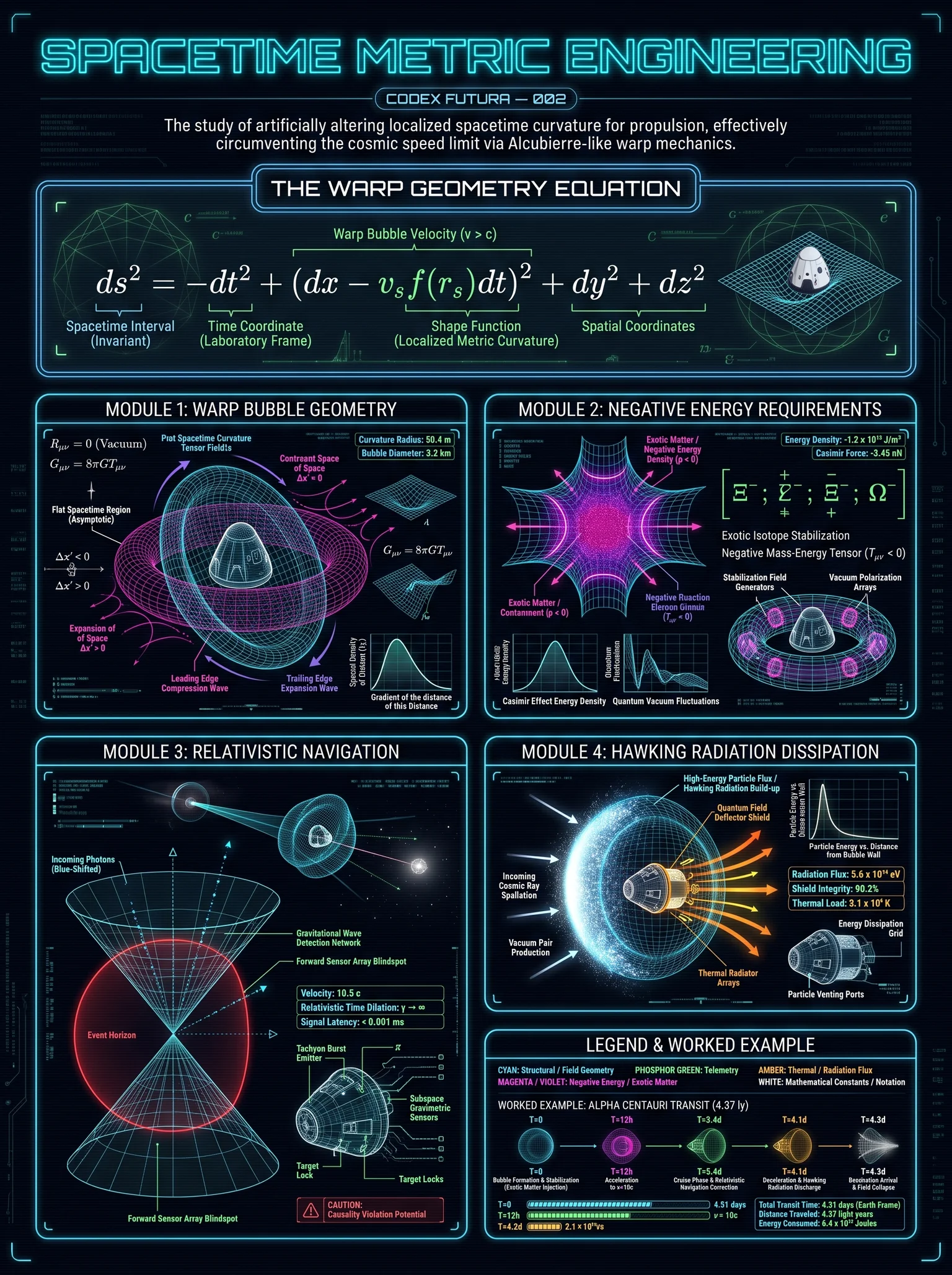
The Warp Geometry Equation
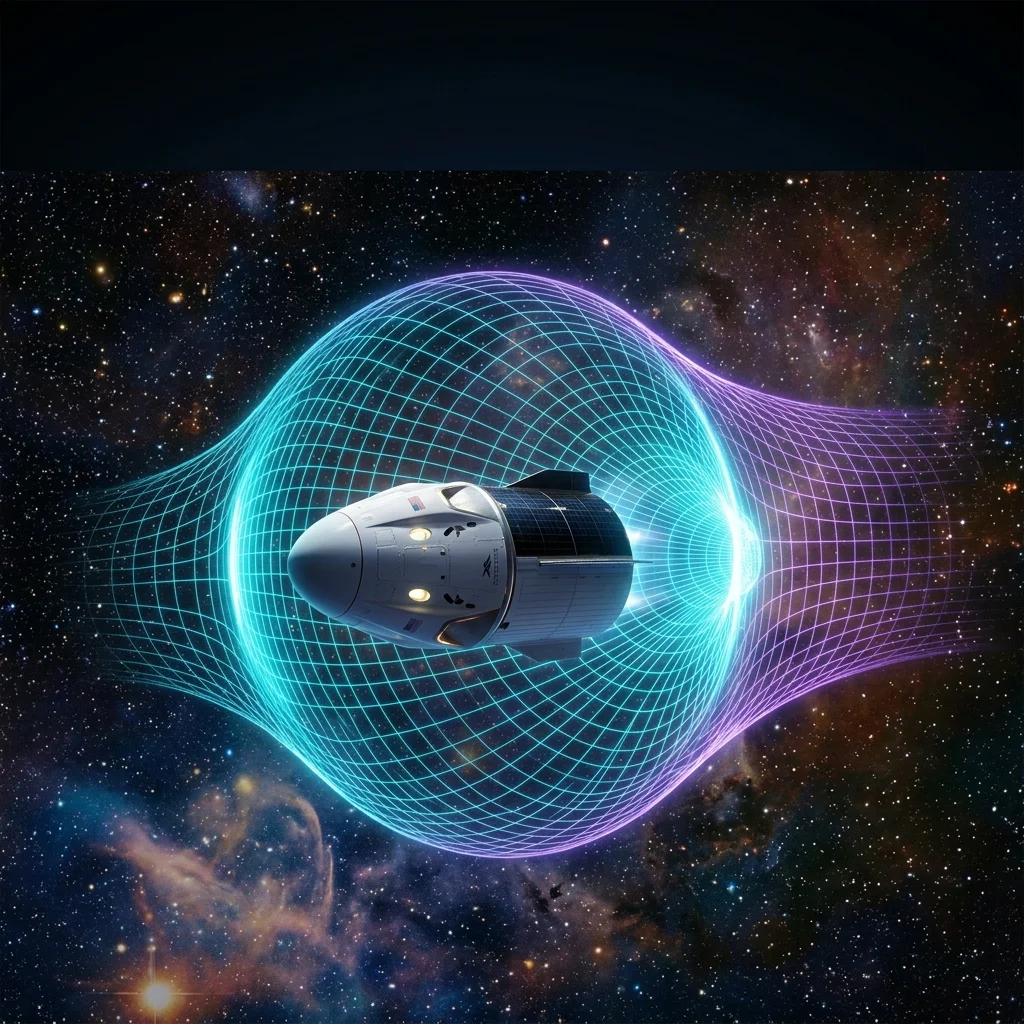
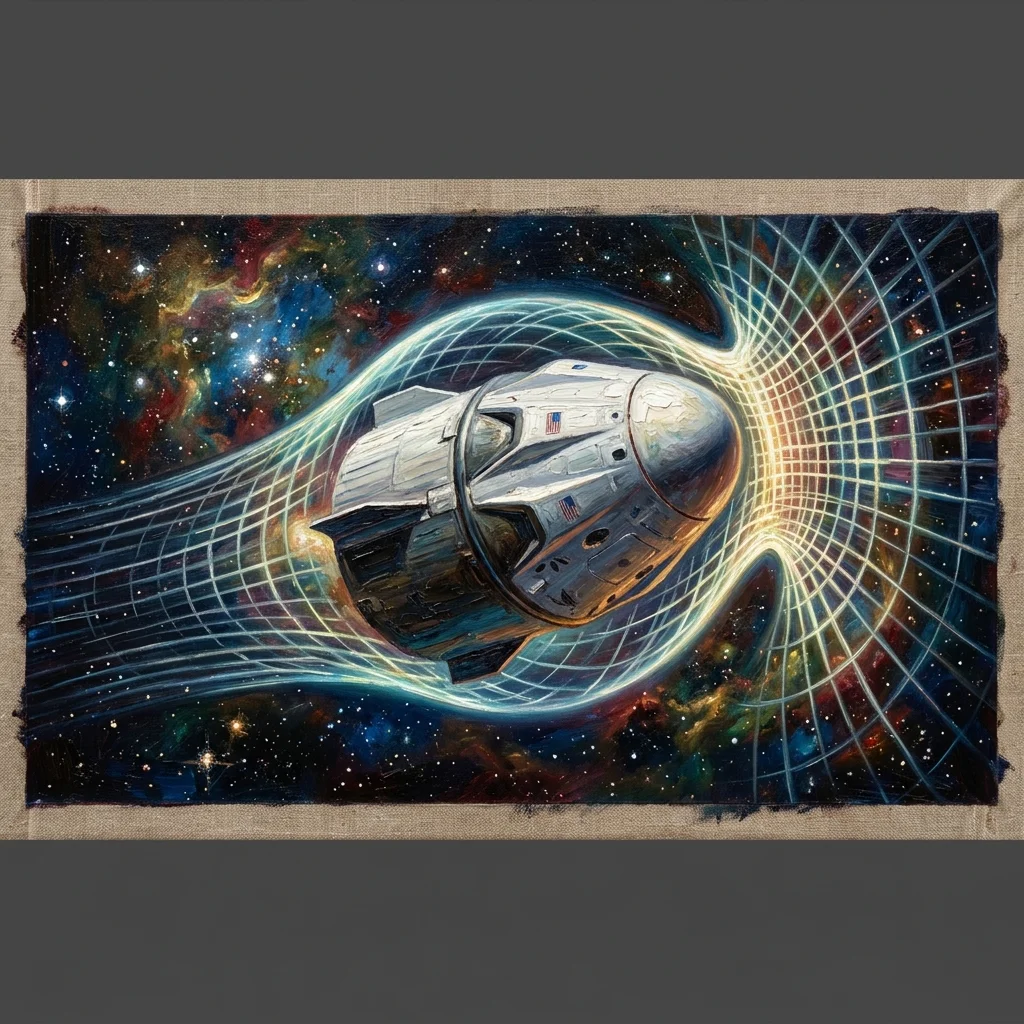
Where Applied General Relativity shapes gravity to hold a habitat still, Spacetime Metric Engineering shapes it to move. The vessel never breaks the light barrier locally — instead the metric itself is re-authored so that space contracts ahead and expands behind, carrying an inertial bubble along a geodesic. The vessel sits at rest inside a wave of its own curvature; the cosmic speed limit is respected and circumvented in the same stroke.
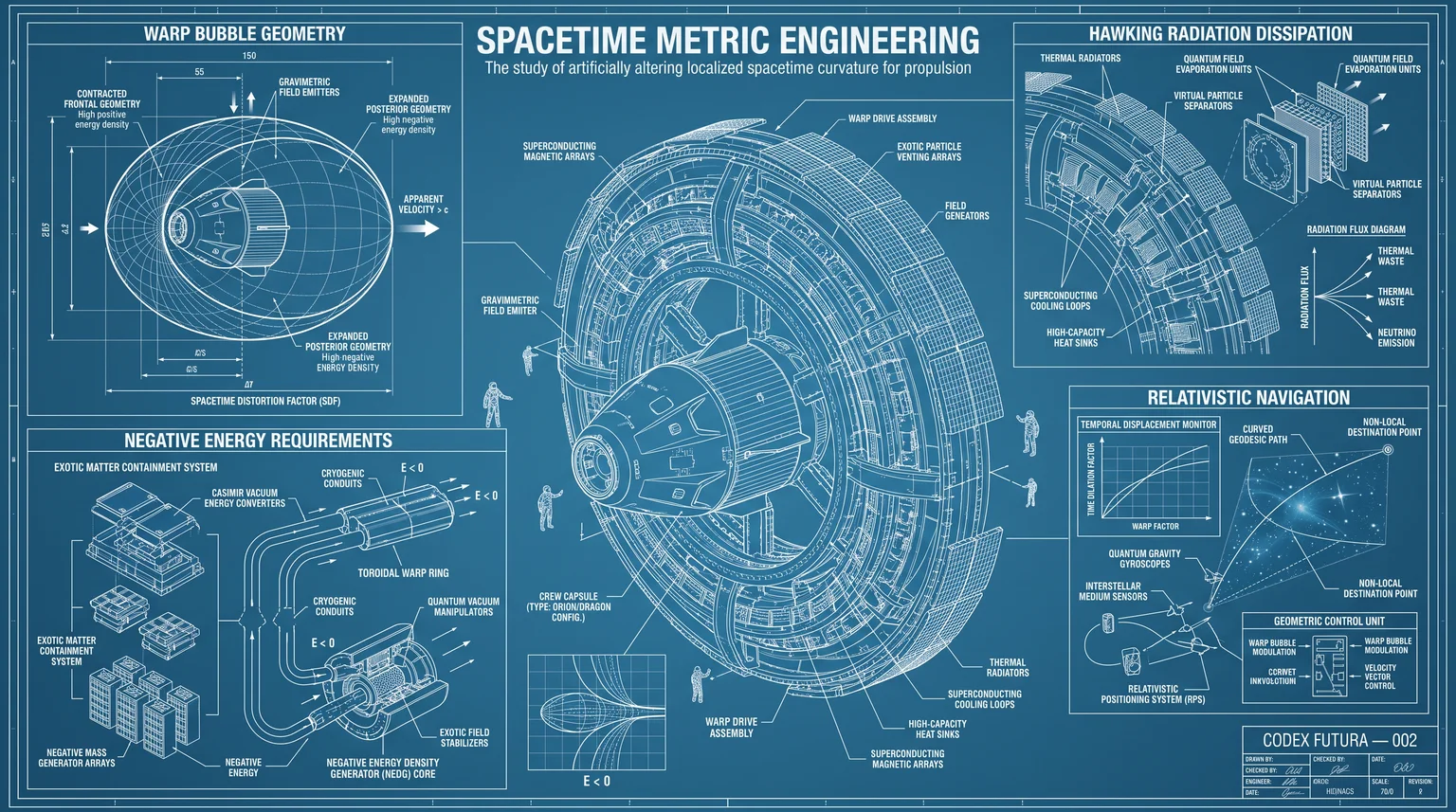
Warp Bubble Geometry
Designing the exact mathematical topology of the spacetime bubble that contracts space ahead of a vessel and expands space behind it.
Negative Energy Requirements
Sourcing and stabilizing exotic matter with negative mass/energy density to keep the warp bubble's throat open and prevent immediate collapse.
Relativistic Navigation
Operating sensors and guidance arrays that can perceive and react to incoming obstacles while traveling at superluminal (faster-than-light) velocities.
Hawking Radiation Dissipation
Managing the intense buildup of high-energy particles at the leading edge of the warp bubble to prevent catastrophic energetic discharge upon deceleration.
Rigorous Analysis · The Physics Reality Check
Editor's noteSpacetime Metric Engineering investigates the theoretical formulation and physical realization of Alcubierre warp geometries, Eulerian shift vectors, exotic stress-energy tensors, and Hawking radiation mitigation for superluminal transport.
01 The Alcubierre Metric Tensor & Eulerian Shift
In 3+1 ADM spacetime decomposition, the metric tensor for a warp bubble propagating along the -axis at velocity is expressed as:
where is the radial distance from the center of the passenger capsule, and is a smooth shaping function regulating bubble wall thickness :
02 Energy Density & Exotic Matter Requirements
The Eulerian observer energy density required to maintain the warp bubble geometry is calculated from Einstein's Field Equations:
Because , everywhere along the bubble wall, requiring negative mass-energy density that violates the Weak Energy Condition (WEC).
03 Relativistic Horizon & Radiation Mitigation
For superluminal bubble speeds (), an horizon forms at the leading wall of the warp bubble where incoming signals cannot overtake the ship:
Particles and quantum vacuum fluctuations swept up by the bubble wall are blue-shifted to extreme energies, accumulating into a lethal blast wave that must be actively dissipated via electromagnetic defocusing fields upon deceleration.
04 Physical Constraints & Quantum Inequalities
- Ford-Roman Quantum Inequality: Squeezed quantum vacuum states can sustain negative energy densities only for extremely short temporal duration .
- Van Den Broeck Geometry Optimization: Microscopic throat diameters paired with macroscopic interior volumes reduce total exotic energy requirements from stellar-mass equivalents down to milligrams.
- Chronology Protection: Superluminal warp trajectories must avoid closed timelike curves (CTCs) to preserve causal order across lorentzian manifolds.