Volume I · Spacetime & Gravitational Mechanics
Applied General Relativity
The engineering of localized gravity fields for artificial gravity and inertial dampening.
Formal Research Monograph · Lead Author: Prof. Alistair Finch
Applied General Relativity: Formal Research Paper
Full 2-column research paper published in PHYSICAL REVIEW RESEARCH featuring complete tensor derivations, field equations, 3D simulation figures, vector telemetry, and peer-reviewed citations.
The Framework
The Metric Manipulation Equation
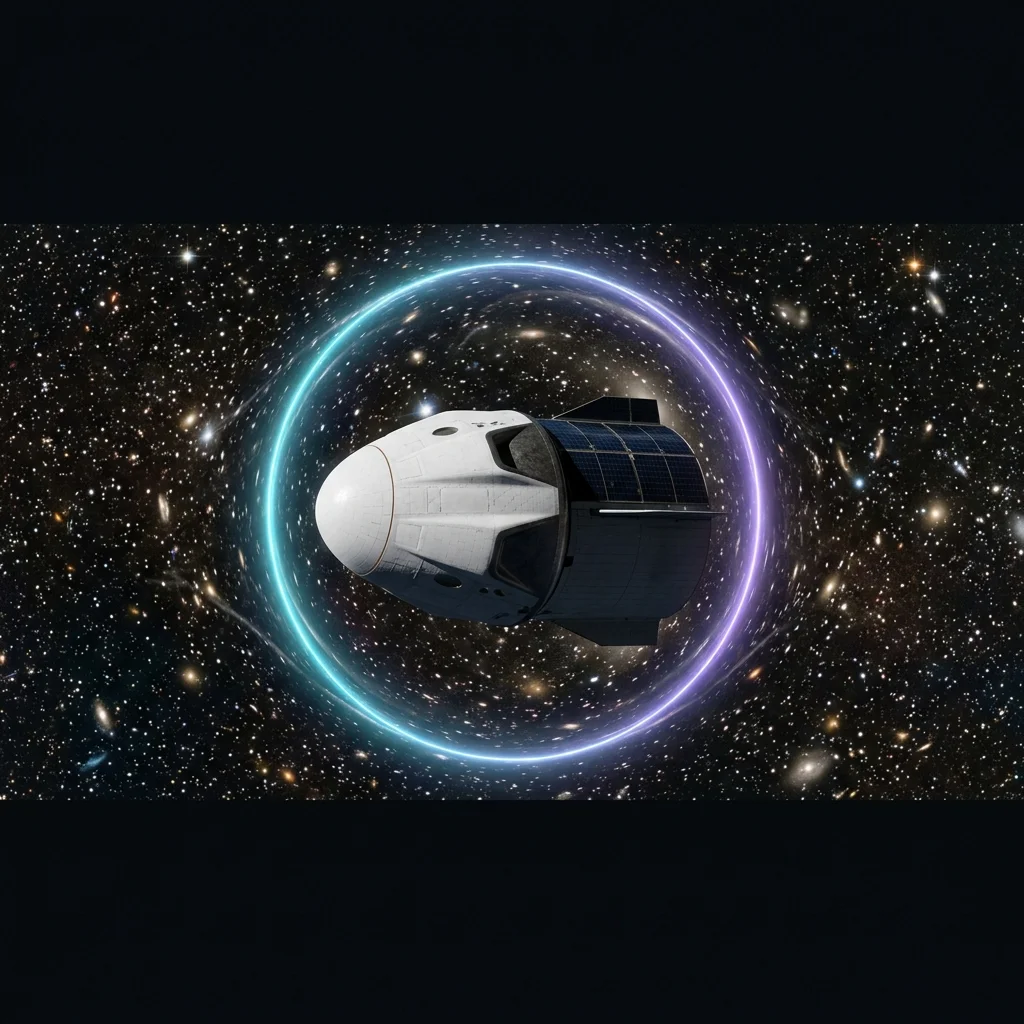
General relativity, in its native form, is a descriptive science: it tells us how mass tells spacetime to curve, and how curved spacetime tells mass to move. Applied general relativity inverts the arrow — it treats the metric as something to be authored rather than merely observed. The engineering problem is to source a stress-energy distribution on demand, hold it stable, and shape the resulting curvature into a field a habitat can live inside.
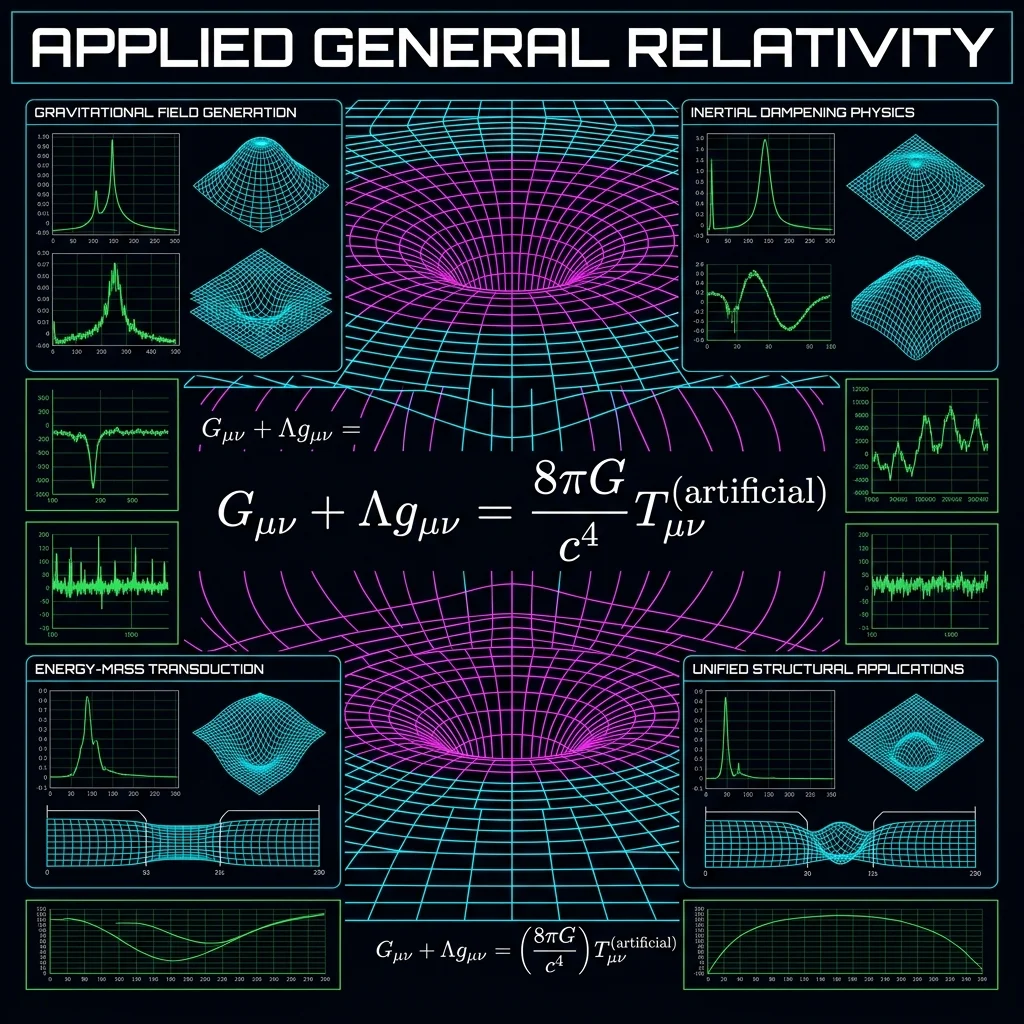
Gravitational Field Generation
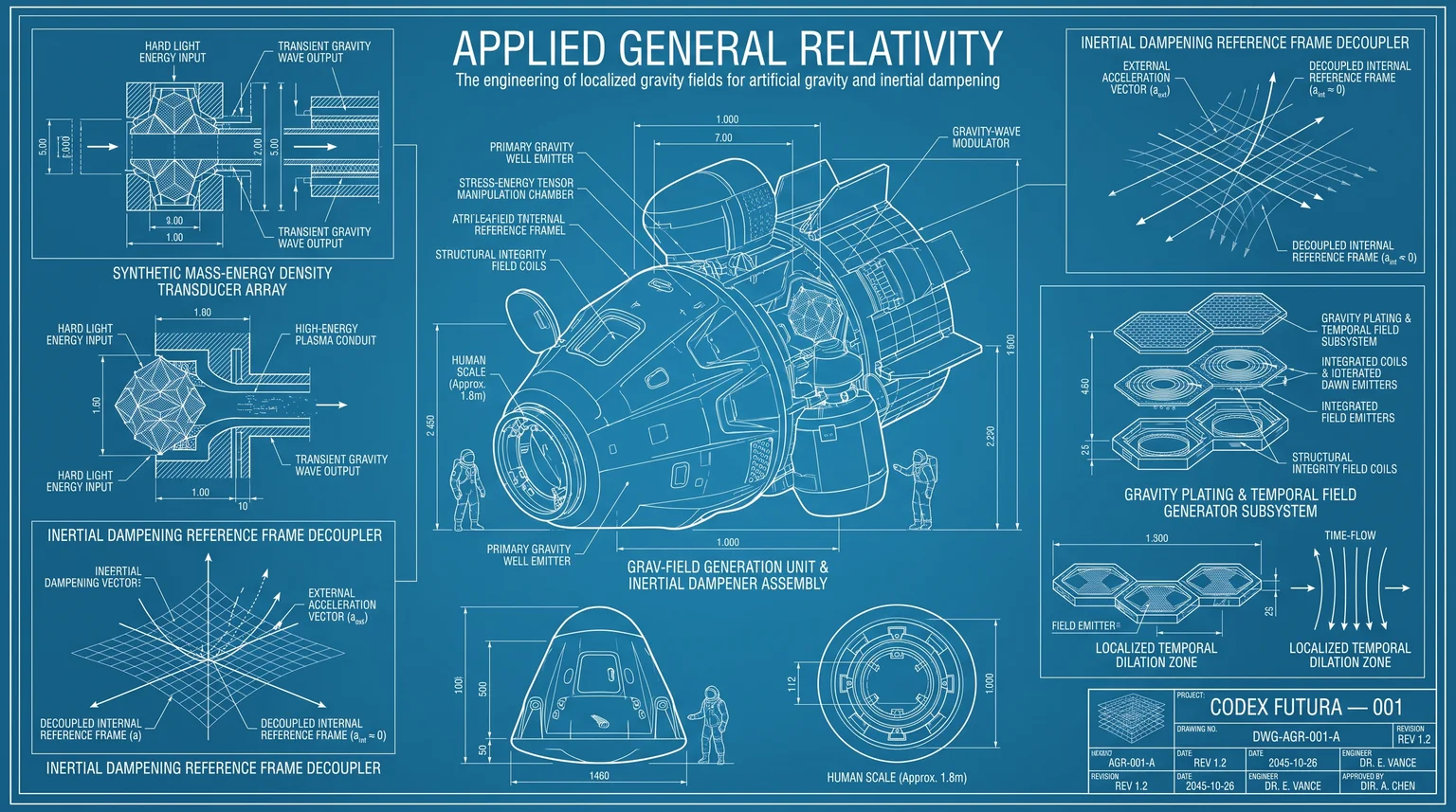
The macroscopic manipulation of the stress-energy tensor to produce localized gravitational wells without relying on massive celestial bodies. This involves deploying synthetic mass-energy densities.
Inertial Dampening Physics
The bridging of localized reference frames to decouple a spacecraft's internal environment from external acceleration vectors, allowing organisms to survive high-G maneuvers.
Energy-Mass Transduction
The physical hierarchy of converting vast amounts of directed energy — such as hard light or plasma — into transient, stable gravitational waves.
Unified Structural Applications
The practical engineering of gravity plating and localized temporal fields for long-duration spaceflight, ensuring bone-density preservation.
Rigorous Analysis · The Physics Reality Check
Editor's noteApplied General Relativity investigates the theoretical engineering of localized metric tensors to create artificial gravitational fields and inertial dampening without massive celestial bodies. This analysis evaluates stress-energy requirements, energy conditions, and frame-decoupling dynamics.
01 Metric Manipulation & Stress-Energy Engineering
Standard General Relativity relates the geometry of spacetime to energy distribution via Einstein's Field Equations:
To engineer a localized gravitational field , an engineered stress-energy tensor must be configured. For a spherically symmetric artificial gravity field, the metric perturbation takes the linearized form:
where represents the target artificial gravitational potential field.
02 Inertial Dampening & Geodesic Motion
Inertial dampening decouples a vehicle's internal occupants from extreme acceleration vectors. By modifying the local Christoffel symbols , the geodesic equation for passengers inside the field envelope becomes:
When the artificial potential gradient matches external ship acceleration , internal passengers remain in free-fall relative to the metric bubble, experiencing zero effective G-force:
03 Energy Condition Bounds
Generating custom metric curvatures frequently violates classical energy conditions. The Weak Energy Condition (WEC) dictates that for any timelike vector :
Creating repulsive gravitational horizons or exotic warp metrics requires negative energy density (), which can be sourced only via squeezed quantum vacuum states or Casimir cavity configurations constrained by Quantum Inequalities:
04 Real-World Physics Limits
- Mass-Energy Requirement: Producing 1 G of artificial acceleration over a 20-meter diameter sphere without celestial mass requires mass-energy densities on the order of .
- Horizon Instabilities: Sharp metric potential gradients can create event-horizon-like surfaces, generating Unruh-Hawking thermal noise that threatens vehicle electronics.
- Causality Protection: Closed timelike curves (CTCs) must be dynamically suppressed via Ford-Roman quantum inequality bounds.