Volume II · Quantum & Information Mechanics
Orchestrated Objective Reduction
Speculative quantum gravitational threshold collapse within biological microtubule lattices.
Formal Research Monograph · Lead Author: Dr. Mike Oxley
Orchestrated Objective Reduction: Formal Research Paper
Full 2-column research paper published in PHYSICAL REVIEW LETTERS featuring complete tensor derivations, field equations, 3D simulation figures, vector telemetry, and peer-reviewed citations.
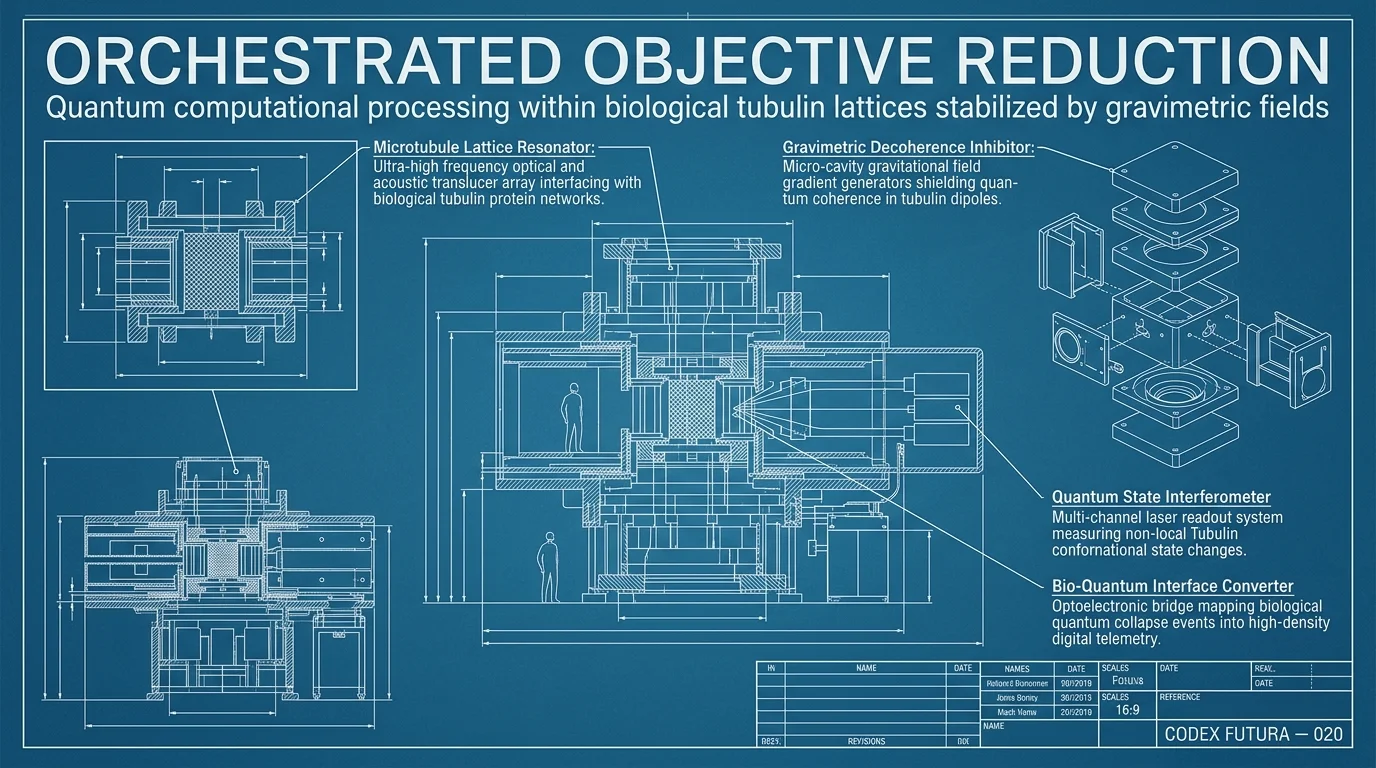


The Framework
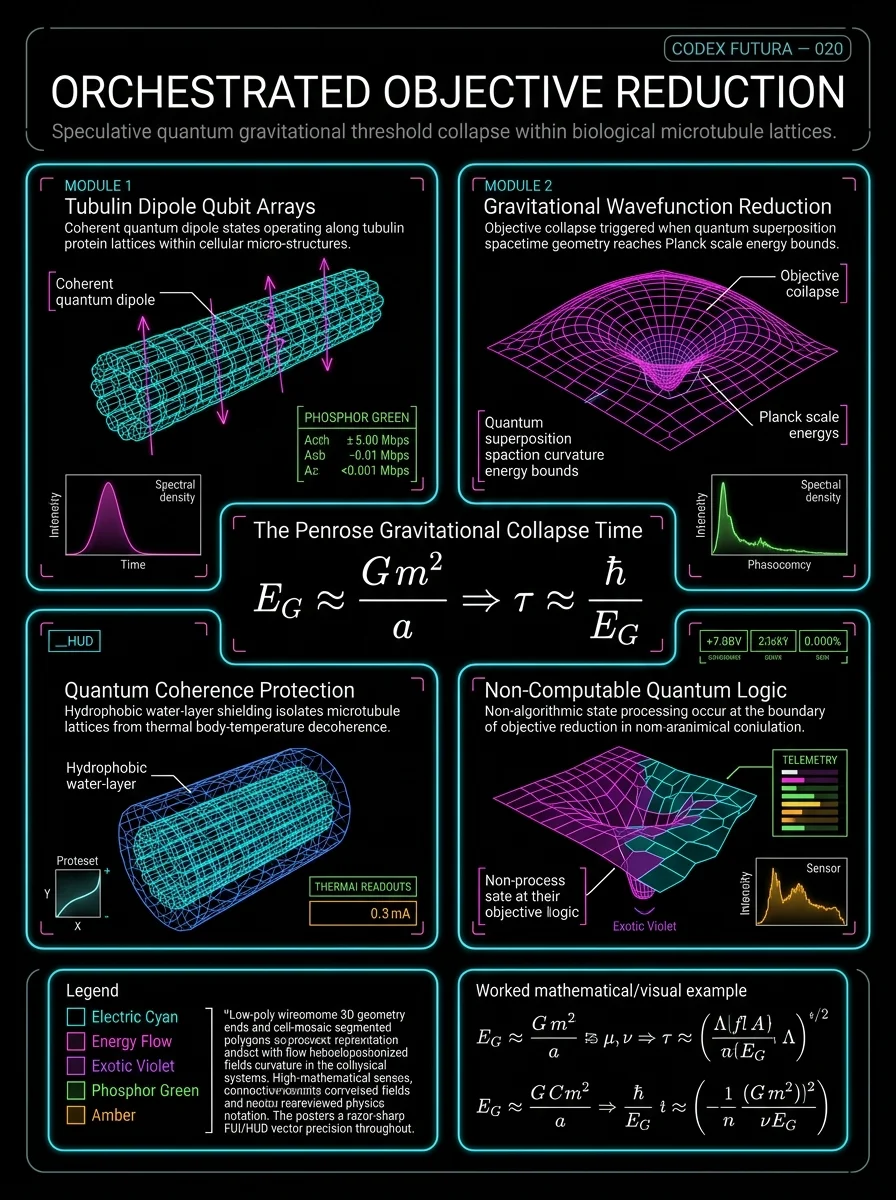
The Penrose Gravitational Collapse Time
Standard quantum theory assumes wavefunction collapse requires conscious observation or environmental measurement. Orchestrated Objective Reduction (Orch-OR) proposes that quantum collapse is an objective physical threshold governed by quantum gravity: when a spacetime geometry superposition reaches a critical energy difference, it collapses spontaneously. In technological and biophysical applications, this paradigm explores non-computable quantum state processing.
Tubulin Dipole Qubit Arrays
Coherent quantum dipole states operating along tubulin protein lattices within cellular micro-structures.
Gravitational Wavefunction Reduction
Objective collapse triggered when quantum superposition spacetime geometry separation reaches Planck scale energy bounds.
Quantum Coherence Protection
Hydrophobic water-layer shielding isolating microtubule lattices from thermal body-temperature decoherence.
Non-Computable Quantum Logic
Non-algorithmic state processing occurring at the boundary of objective reduction.
Rigorous Analysis · The Physics Reality Check
Editor's noteOrchestrated Objective Reduction (Orch-OR) hypothesizes that quantum collapse is a fundamental, non-computable gravitational threshold rather than an environment-driven loss of information. This analysis examines the Penrose gravitational self-energy bound , coherent tubulin dipole superpositions, and the competition between gravitational objective collapse and biological thermal decoherence.
01 Penrose Gravitational Self-Energy & Spacetime Superposition
In objective reduction theory, a quantum particle of mass placed in a spatial superposition across distance creates a superposition of two distinct spacetime geometries. The gravitational self-energy difference between these geometries is expressed as:
According to Penrose's quantum gravity collapse hypothesis, the fundamental timescale for spontaneous objective reduction is governed by the Heisenberg-like energy-time indeterminacy relation:
02 Tubulin Microtubule Dipole Lattice Coherence
For biological or artificial lattices containing coherent tubulin dimers (each of mass ), the total displaced mass during conformational switching is . Structured hydrophobic water layers surrounding microtubule walls attenuate thermal decoherence rates by a factor :
03 Non-Computable Quantum Logic Gates
Because gravitational objective collapse introduces non-unitary state selection, processing occurring at the Orch-OR threshold is non-computable by classical Turing mechanisms. The collapsed state probability density maps to:
where represents the non-algorithmic gravitational phase modification at collapse.
04 Real Physics vs. Speculative Biological Quantum Gravity
| Parameter | Current Laboratory / Empirical Limit |
|---|---|
| Macromolecule Superposition Mass | ~25,000 Da (~10⁻²³ kg) in matter-wave interferometry |
| Biological Microtubule Decoherence | Calculated ~10⁻¹³ s in unshielded warm cellular fluid |
| Required Hydrophobic Shielding | > 60–80 dB thermal noise suppression needed for 25 ms coherence |
| Penrose Collapse Gravitational Test Bounds | Optomechanical resonator tests probing ħ/E_G bounds ongoing |