Volume II · Quantum & Information Mechanics
Macroscopic Quantum Entanglement Routing
The high-throughput distribution, routing, and swapping of multi-particle Bell pairs across planetary and orbital scales.
Formal Research Monograph · Lead Author: Prof. Alistair Finch
Macroscopic Quantum Entanglement Routing: Formal Research Paper
Full 2-column research paper published in PHYSICAL REVIEW APPLIED: METRIC ENGINEERING featuring complete tensor derivations, field equations, 3D simulation figures, vector telemetry, and peer-reviewed citations.
The Framework
The Entanglement Distribution & Swapping Matrix
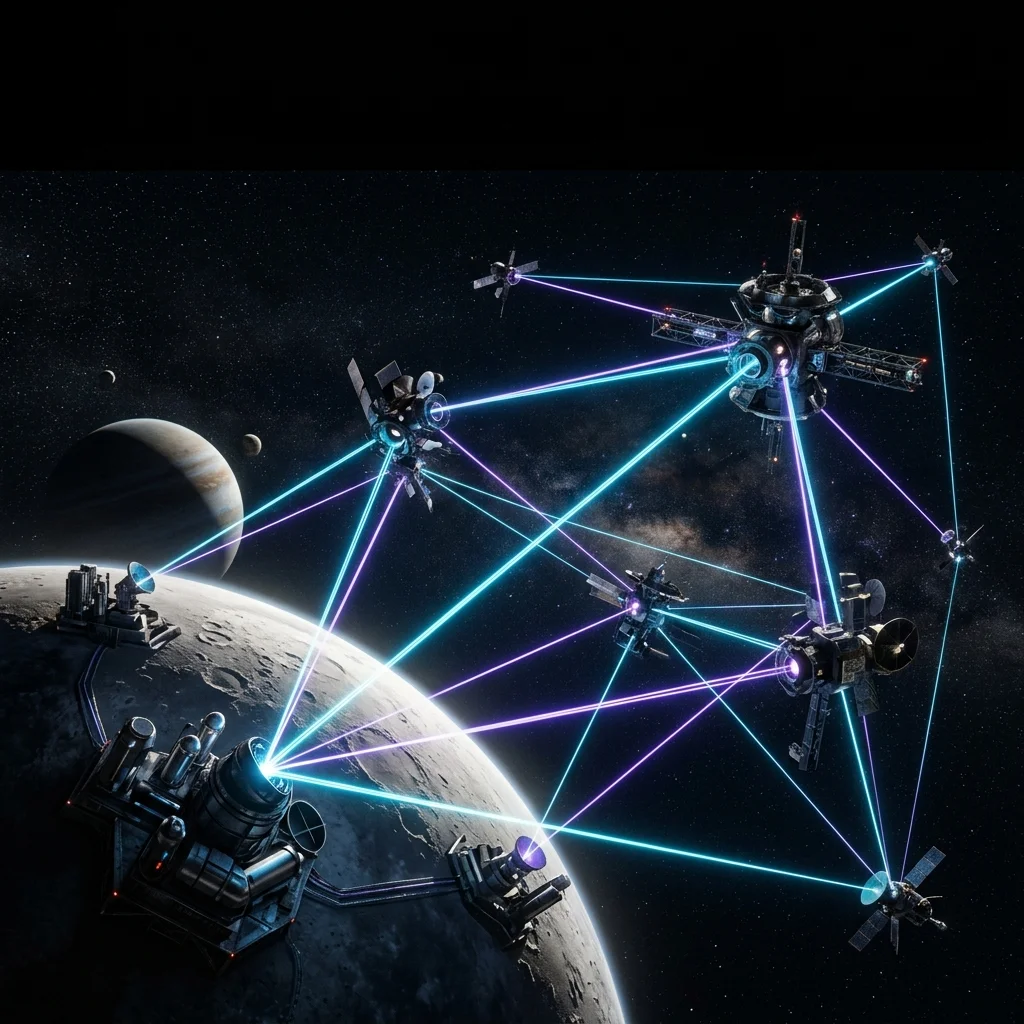
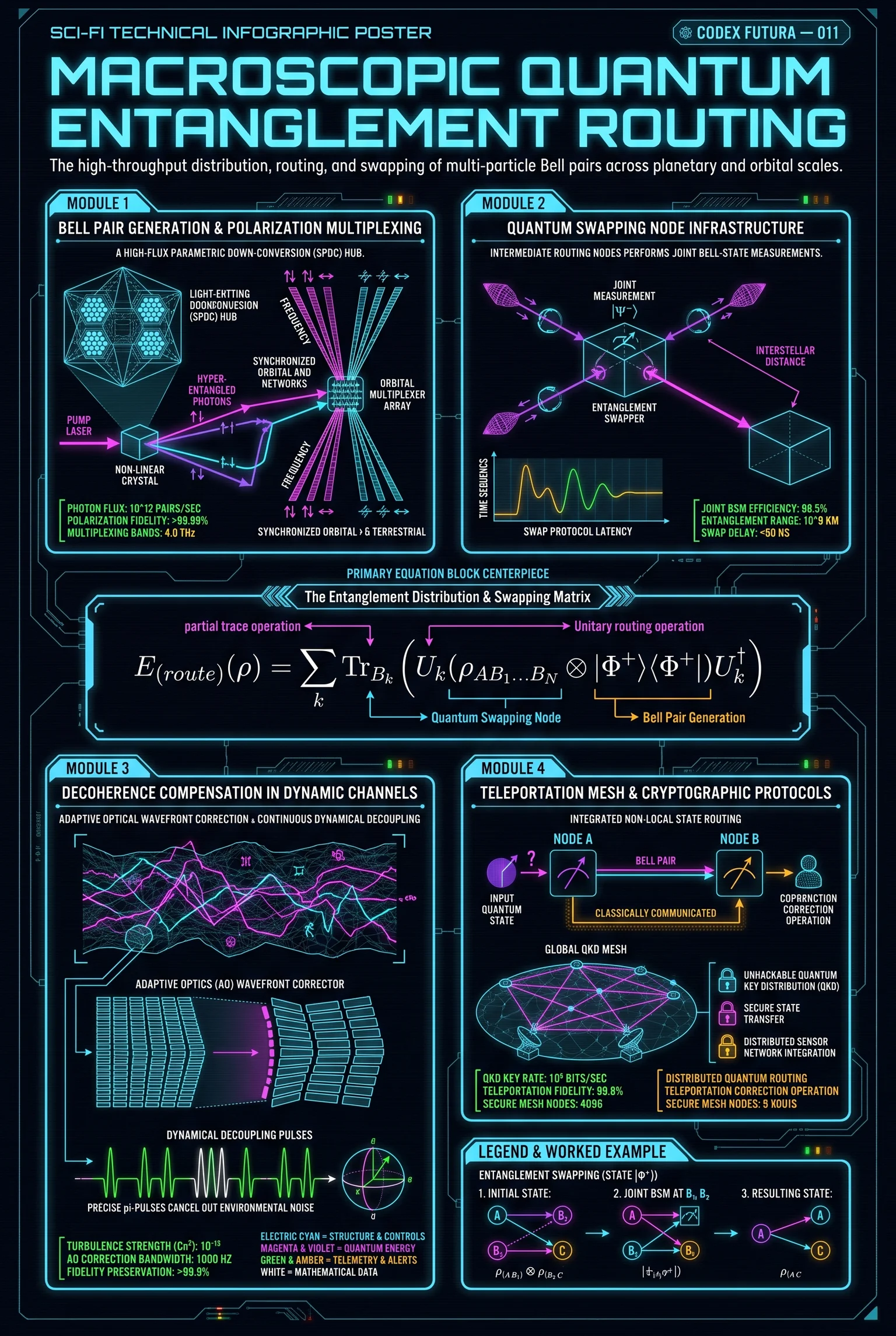
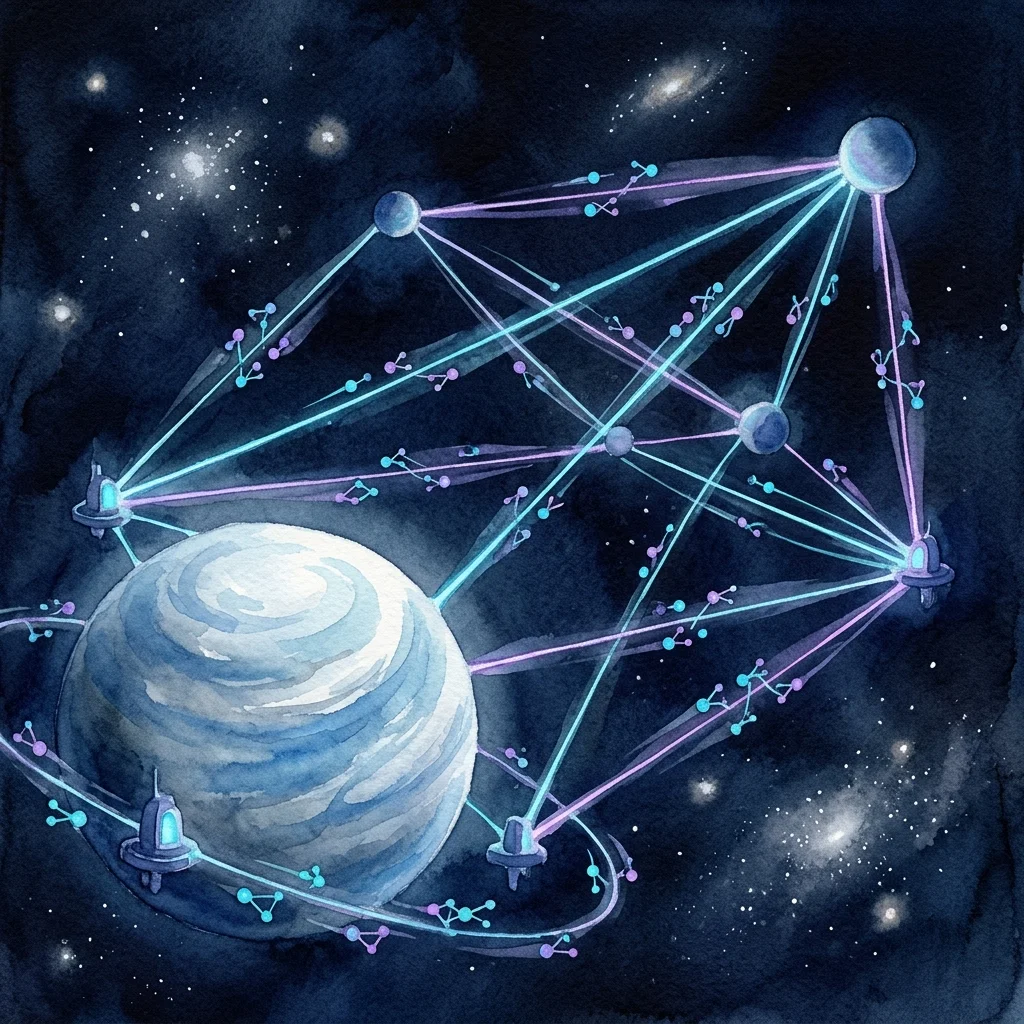
Quantum entanglement, in foundational physics, is observed at atomic and optical micro-scales: measuring one entangled particle immediately dictates the state of its paired partner regardless of distance. Macroscopic Quantum Entanglement Routing elevates this phenomenon into a planetary telecommunications paradigm — treating quantum non-locality not as a laboratory curiosity, but as a engineered physical transport layer. By orchestrating high-flux Bell pair sources with atomic-scale quantum swapping relays, physical state information and cryptographic keys are routed dynamically across solar-system scale distances with zero classical latency in state collapse.
Bell Pair Generation & Polarization Multiplexing
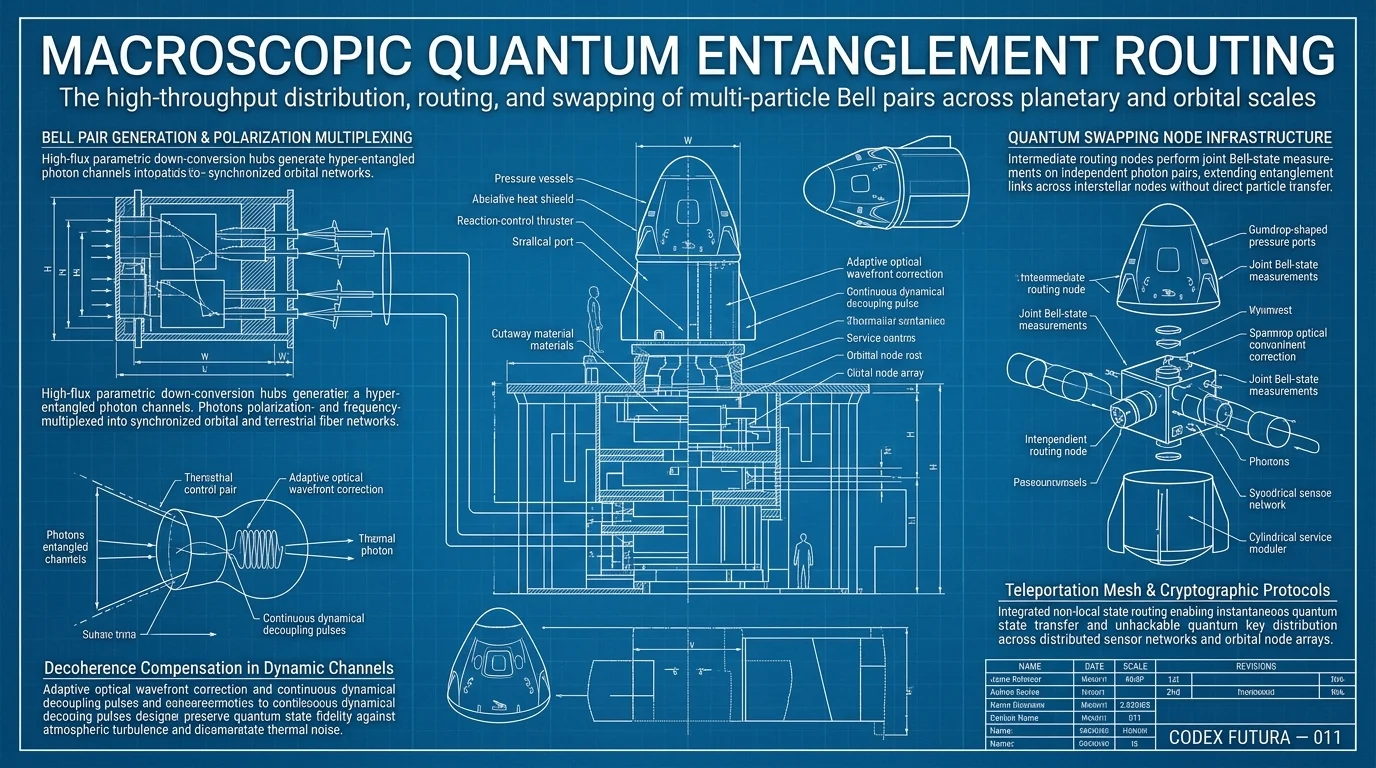
High-flux parametric down-conversion hubs generating hyper-entangled photon channels. Photons are polarization- and frequency-multiplexed into synchronized orbital and terrestrial fiber networks.
Quantum Swapping Node Infrastructure
Intermediate routing nodes performing joint Bell-state measurements on independent photon pairs, extending entanglement links across interstellar nodes without direct particle transfer.
Decoherence Compensation in Dynamic Channels
Adaptive optical wavefront correction and continuous dynamical decoupling pulses designed to preserve quantum state fidelity against atmospheric turbulence and thermal noise.
Teleportation Mesh & Cryptographic Protocols
Integrated non-local state routing enabling instantaneous quantum state transfer and unhackable quantum key distribution across distributed sensor networks and orbital node arrays.
Rigorous Analysis · The Physics Reality Check
Editor's noteMacroscopic Quantum Entanglement Routing applies quantum optical non-locality to planetary scales. This analysis evaluates quantum state transfer fidelity, photon loss limits, and atmospheric/space channel noise bounds.
01 Bell Pair Distribution & Quantum Non-Locality
The standard bipartite Bell state distributed across two distant nodes and is represented as:
In macroscopic routing, transmission losses over atmospheric and optical fiber channels attenuate photon count exponentially according to Beer-Lambert loss:
where is attenuation in dB/km and is transmission distance.
02 Entanglement Swapping & Multi-Hop Relays
Direct transmission over thousands of kilometers leads to prohibitive loss. Quantum swapping relays perform joint Bell-state measurements (BSM) on independent photon pairs, entangling end nodes that never physically interacted:
03 No-Cloning Theorem & Amplification Limits
Unlike classical signals, quantum states cannot be cloned or amplified by standard linear amplifiers due to the No-Cloning Theorem:
Quantum repeaters must therefore rely on quantum memory buffers, entanglement purification, and herald-based state generation.
04 Real Physics Constraints vs. Speculative Mesh
| Requirement | Current Physical Limit |
|---|---|
| Fiber Distance | ~500 km without repeaters |
| Satellite-to-Ground | ~1,200 km (Micius satellite) |
| Quantum Memory Lifetime | Milliseconds to seconds (cryogenic) |
| BSM Success Efficiency | 50% linear optics limit (without ancilla) |