Volume I · Spacetime & Gravitational Mechanics
Chronometric Engineering
The controlled construction of closed timelike curves and localized temporal gradients, enabling causality-bounded time displacement and extreme time-dilation shelters.
Formal Research Monograph · Lead Author: Dr. Simon Hadley
Chronometric Engineering: Formal Research Paper
Full 2-column research paper published in JOURNAL OF HIGH ENERGY PHYSICS featuring complete tensor derivations, field equations, 3D simulation figures, vector telemetry, and peer-reviewed citations.
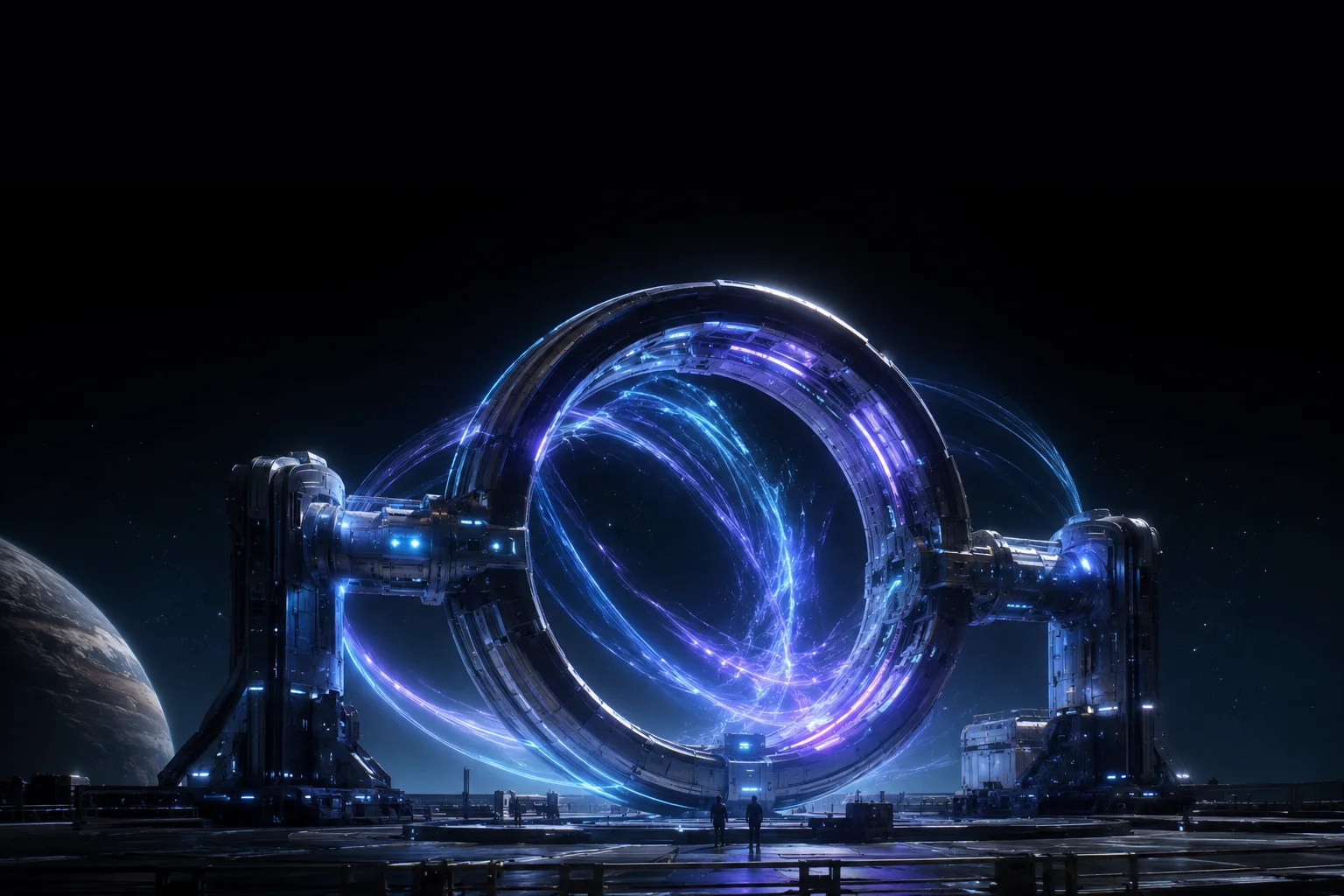
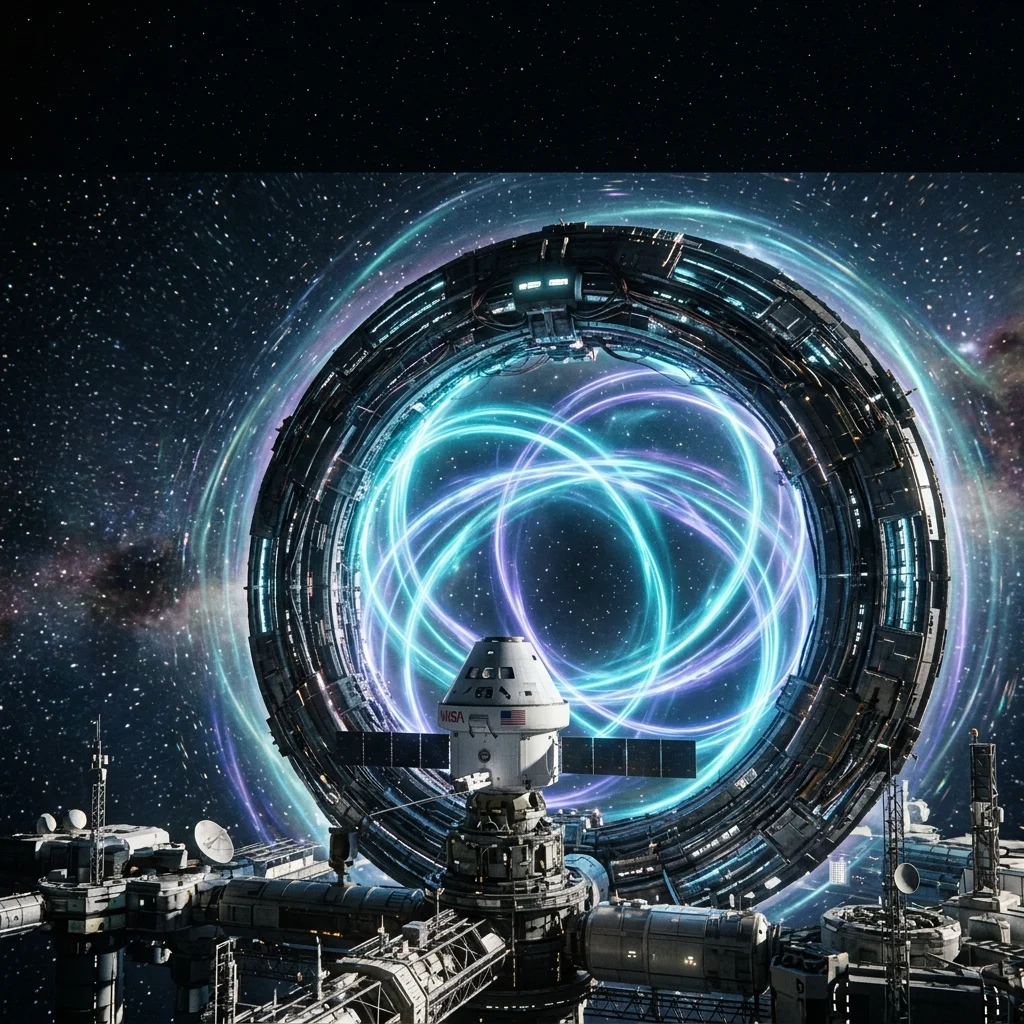
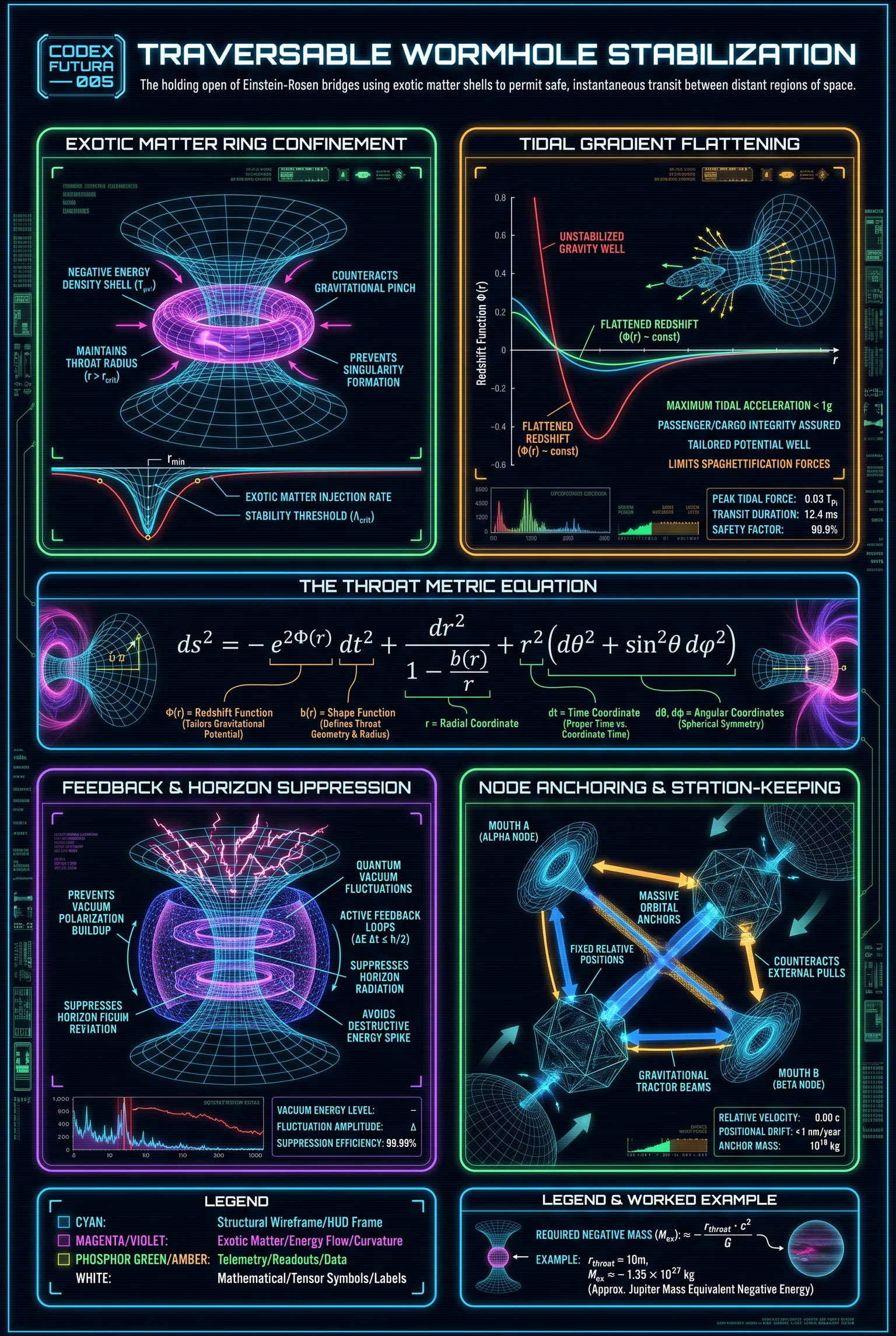
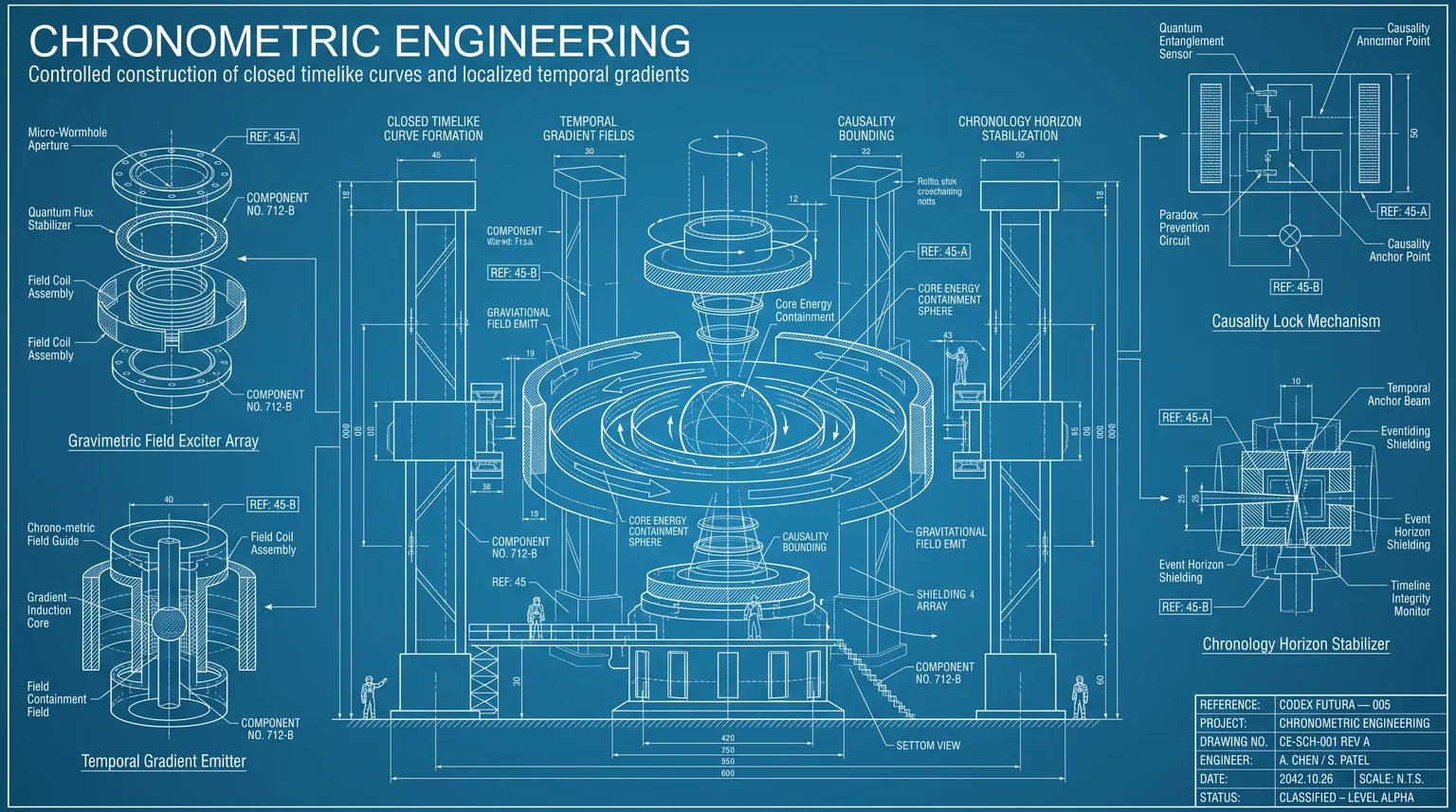
The Framework
The Proper-Time Circulation Equation
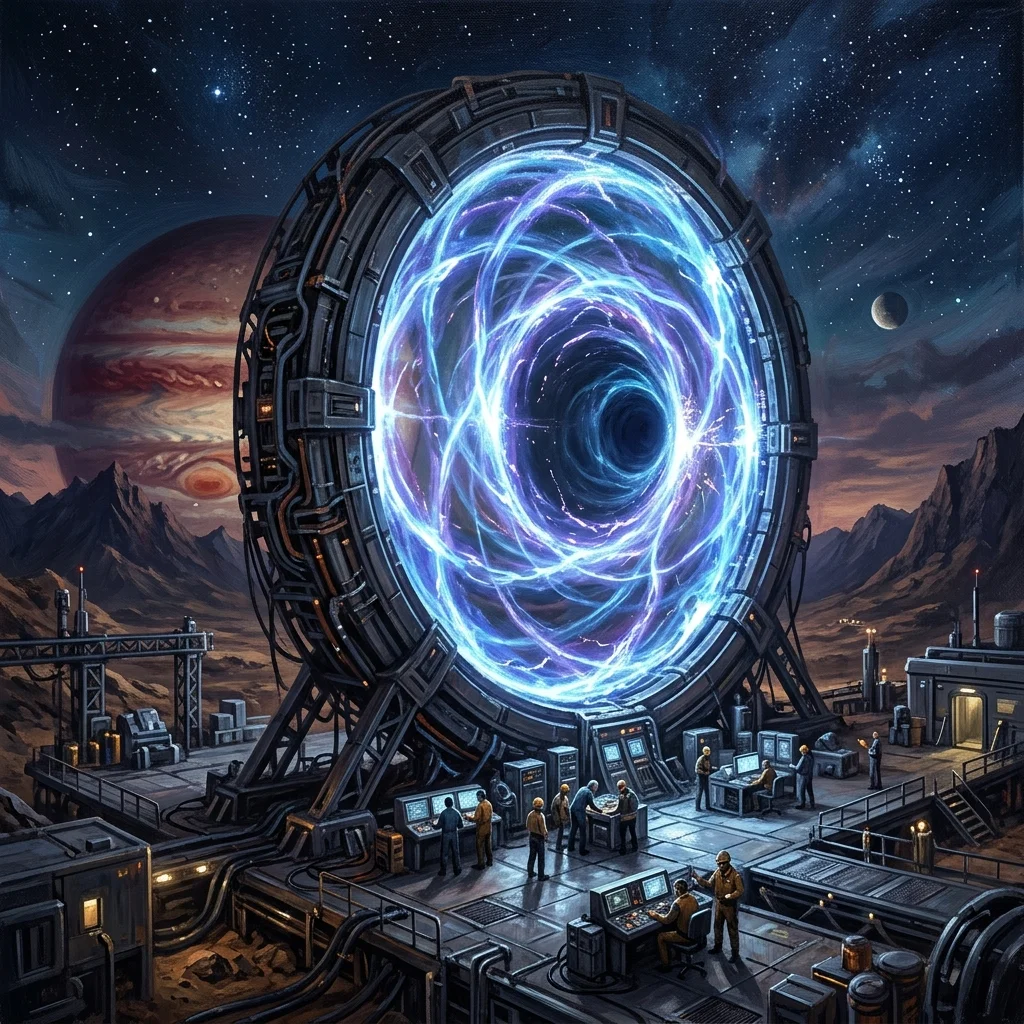
Relativity already lets time run at different rates for different observers; Chronometric Engineering makes that difference a control surface. At its gentle end it is a shelter where centuries pass outside in an afternoon within. At its extreme it curls a worldline back on itself — a closed timelike curve — and the discipline becomes less about propulsion than about protecting causality from the very machine that bends it.
Closed Timelike Curve Formation
Winding spacetime into loops — via rotating ultra-dense cylinders or paired wormhole mouths — along which a worldline can return to its own past.
Temporal Gradient Fields
Establishing steep, stable gradients in the flow of proper time across a small region, banking or spending subjective duration on demand.
Causality Bounding
Constraining information flow around the loop with self-consistency conditions so that no paradox-generating signal can ever propagate.
Chronology Horizon Stabilization
Suppressing the runaway vacuum fluctuations that pile up at the boundary where time travel first becomes possible, preventing the horizon from destroying itself.
Rigorous Analysis · The Physics Reality Check
Editor's noteChronometric Engineering examines the general relativistic metric conditions, closed timelike curve (CTC) circulation integrals, frame-dragging temporal gradients, and Hawking chronology protection mechanisms required for stable temporal displacement.
01 The Proper-Time Circulation Equation & Metric Line Element
In spacetime geometries admitting closed timelike curves, proper time along a closed temporal worldline is computed by integrating the metric line element along the loop:
where is the spacetime metric tensor. When the azimuthal component becomes negative due to extreme frame-dragging or mass rotation, curves of constant become timelike (), allowing observers to complete closed loops in time.
02 Frame-Dragging & Tipler Cylinder CTC Thresholds
For an infinitely long cylinder of dense matter rotating with angular momentum per unit mass , the frame-dragging angular velocity tilts local light cones past the vertical time axis:
Beyond the critical radius , light cones tilt beyond , transforming the spatial coordinate into a timelike direction and opening closed timelike paths without exceeding local speed-of-light constraints.
03 Novikov Self-Consistency & Quantum Chronology Protection
Hawking's Chronology Protection Conjecture posits that quantum vacuum stress-energy tensors diverge near the Cauchy horizon , where closed null geodesics first form:
To prevent catastrophic vacuum feedback from destroying the horizon, Chronometric Engineering applies localized active field damping , enforcing the Novikov Self-Consistency Principle wherein global probabilities for paradox-generating histories vanish identically ().